
Idealism in F1 Motorsports
The Eternal Tension between Pragmatism and Idealism, Reality and Dream.

Formula 1 has always existed in a delicate balance between idealism and pragmatism. For decades, the sport has been a canvas upon which fans, drivers, engineers, and team principals project their visions of what racing *should* be-a pure contest of skill, innovation, and courage. Yet beneath this romantic veneer lies a complex ecosystem driven by commercial interests, political manoeuvring, and the relentless pursuit of competitive advantage.
The Romantic Ideal
At its core, the idealistic vision of Formula 1 is beautifully simple; the best drivers, in the best cars, competing on the world’s most challenging circuits. It’s a vision of pure sporting meritocracy where talent alone determines victory. The idealism manifests in several key beliefs:
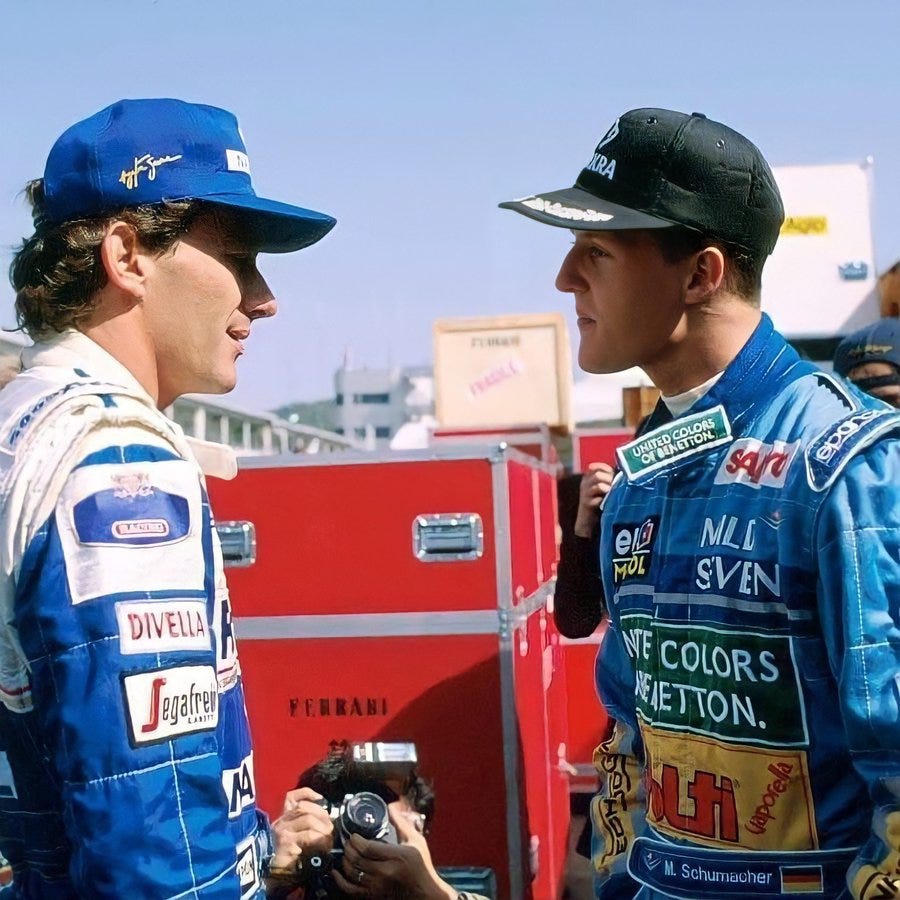
The Driver as Hero: The romantic notion that a truly exceptional driver can overcome any mechanical disadvantage through sheer skill and determination. Think of Ayrton Senna’s legendary wet-weather drives, or Michael Schumacher’s ability to extract performance from inferior machinery. These moments reinforce the belief that human excellence can transcend technical limitations.

Engineering Purity: The ideal that Formula 1 should be the ultimate expression of automotive innovation-where brilliant minds push the boundaries of physics, materials science, and aerodynamics. The sport should reward creativity and technical excellence, not just financial resources.
Sporting Integrity: The belief that rules should be clear, enforcement should be consistent, and the best driver-car combination should win on any given Sunday, regardless of politics, money, or external pressures.
The Reality Check
Yet Formula 1’s history is littered with moments that challenge these ideals:
- Money Talks: The correlation between budget and success is undeniable. While smaller teams occasionally punch above their weight, the championship contenders are almost invariably those with the deepest pockets. The cost cap introduced in 2021 was an attempt to address this, but the fundamental tension remains.
- Politics and Strategy: Team orders, strategic retirements, and political manouvering have always been part of the sport. The infamous “Multi-21” incident, or “Ferrari’s team orders at Austria 2002, remind us that Formula 1 is as much about team strategy as individual driver performance.
- Regulatory Complexity: The rulebook has grown increasingly complex, creating opportunities for teams to exploit gray areas. The “bendy wing” controversies, fuel flow sensors, and various technical directives highlight how the pursuit of competitive advantage can clash with the spirit of the regulations.
Moments of Pure Idealism
Despite these challenges, Formula 1 has produced moments that perfectly capture the idealistic vision:
- Senna vs. Prost: Their rivalry, particularly as Suzuka in 1989 and 1990, represented a clash of pure racing philosophies-Prost’s calculated precision versus Senna’s raw, uncompromising passion. Both approaches were valid, both were idealistic in their own way.
- The Underdog Victory: When Pierre Gasly won at Monza in 2020, or when Esteban Ocon triumphed in Hungary in 2021, these moments felt like the sport at its purest-talent and circumstance aligning to create something magical, regardless of team size or budget. In MLOps terms, these are moments when a smaller team’s well-engineered model outperforms a resource-rich competitor’s solution-proving that thoughtful feature engineering and clean data pipelines can sometimes trump raw computational power.
- Technical Innovation: The introduction of ground effect aerodynamics, the development of hybrid power units, and innovations like DRS and ERS represent the idealistic pursuit of making racing both faster and more engaging.
- Radical Engineering Experiments: Perhaps no examples better capture engineering idealism than Honda’s free-thinking engine designs of the 1980s and the six-wheeled Tyrrell P34. Honda’s engineers, unbound by unconventional wisdom, developed revolutionary V6 turbocharged engines that defied traditional combustion chamber designs, following their vision regardless of immediate practical limitations or industry skepticism.
Similarly, the Tyrell P34’s six-wheel design-four small front wheels and two standard rear wheels-was born from pure engineering idealism. Designer Derek Gardner followed a vision that challenged fundamental assumptions about vehicle dynamics, believing that smaller front wheels would reduce drag and improve aerodynamics. While the car achieved some success (including a 1-2 finish at the 1976 Swedish Grand Prix), it ultimately proved too complex to develop further. Yet it remains a perfect symbol of idealism: engineers pursuing an idea because they believed it could work, not because conventional wisdom suggested it would.
The Modern Tension
Today’s Formula 1 exists in an interesting space. On one hand, Liberty Media’s ownership has brought unprecedented commercial success and global reach. The Netflix series Drive to Survive has introduced millions of new fans to the sport, expanding its appeal beyond traditional motorsport enthusiasts.
On the other hand, this commercial success has raised questions about whether the sport is becoming too sanitized, too focused on entertainment value over pure racing. The introduction of sprint races, the push for more street circuits, and the emphasis on “show” over “sport” represent a shift toward a more pragmatic, commercially-driven approach.
The Driver’s Perspective
Many drivers speak about their idealistic vision of Formula 1. Lewis Hamilton has been vocal about using his platform for social change, seeing the sport as a vehicle for broader impact. Max Verstappen, meanwhile, has expressed frustration with what he sees as excessive regulation and “artificial” elements like DRS, preferring a more pure form of racing.
These perspectives highlight a fundamental question: What is Formula 1’s purpose? Is it pure sport? Entertainment"? A platform for technological innovation"? A business? The answer, of course, is all of the above-and that’s where the tension lies.
The Engineering Ideal
For engineers, the idealistic vision is one of unlimited innovation within clear boundaries. The best technical minds should be able to find creative solutions that push the sport forward. Yet the reality is that regulations are often written to prevent certain innovations, creating a cat-and-mouse game between rule-makers and teams.
The introduction of the cost cap represents an interesting compromise-an attempt to level the playing field while still allowing technical innovation. Whether this achieves the idealistic goal of making success more accessible remains to be seen.
The Idealistic Pursuit of Perfect Data-Driven Racing
The application of machine learning and MLOps in Formula 1 represents one of the sport’s most compelling modern expressions of idealism. It embodies the belief that through sophisticated data science, teams can transcend human limitations and achieve something approaching perfect strategic decision-making. Yet, like all idealistic pursuits in F1, this vision exists in constant tension with reality.
The Ideal: Pure Data-Driven Excellence
The idealistic vision of MLOps and F1 is beautifully simple: every decision should be optimized through data. Race strategy should be determined not by intuition or experience alone, but by models that have learned from thousands of races, millions of data points, and countless scenarios. It is the belief that the right algorithm, trained on the right data, can unlock insights that even the most experienced race engineers might miss.
This idealism mirrors the engineering philosophy behind Honda’s radical engine designs or the Tyrrell P34-the conviction that unconventional approaches, properly executed, can yield extraordinary results. In MLOps terms, this means believing that a well-engineered model can predict tire degradation more accurately than human judgment, that anomaly detection algorithms can catch mechanical failures before they become race-ending, and that simulation models can test more configurations in a day than physical testing could in a year.
Race Strategy: The Pursuit of Optimal Decisions
Consider race strategy optimization-one of the most critical applications of ML in F1. The idealistic vision is that ML models can process real-time telemetry, historical patterns, weather forecasts, and competitor behavior to recommend the perfect pit stop window, the optimal tire compound, the ideal fuel load. It is the belief that data can eliminate the guesswork, the “what ifs”, the second guessing that haunts every strategic decision.
Yet the reality is more complex. Models can fail. Data can be incompelete. Edge cases emerge that training data never covered. The MLOps challenge-maintaining reliable models in production, handling real-time data streams, managing model drift-represents the pragmatic counterpoint to this idealism. Teams must balance the ideal of perfect data-driven decisions with the reality that models need human oversight, validation and fallback strategies.
Predictive Tire Modelling: Believing in the Perfect Forecast
Tire degradation prediction exemplifies the idealism of MLOps in F1. The vision is that models can learn the subtle patterns-how track temperature affects compound performance, how driver style influences wear, how weather changes alter grip-to predict exactly when tires will lose optimal performance. It is the pursuit of perfect foresight, the belief that with enough data and the right algorithms, teams can see into the future.
This mirrors the idealism of engineers who believed the P34’s six-wheel design could revolutionize aerodynamics, or that Honda’s unconventional engine architecture could unlock new performance levels. The MLOps infrastructure that enables this-automated retraining pipelines, feature stores, model versioning-represents the practical machinery that makes the idealistic vision possible. But it also highlights the tension: models must be continuously updated as conditions change, requiring teams to balance the ideal of perfect prediction with the reality of constant adaptation.
Driver Performance Analysis: The Quest for Perfect Feedback
The idealistic vision of ML-driven driver analysis is that models can identify the perfect braking point, the optimal cornering line, the ideal throttle application—extracting insights from telemetry that even the driver might not consciously recognize. It is the belief that data can help drivers achieve something approaching the perfect lap, every lap.
Yet this idealism exists alongside the reality that drivers are human, that intuition and feel matter, that sometimes the “perfect” data-driven approach might not account for the driver’s unique style or the car’s specific characteristics.
The MLOps challenge is building systems that enhance rather than replace driver skill—systems that provide insights while respecting the art of driving.
The Tension: Idealism vs. Pragmatism in Production
The most idealistic aspect of MLOps in F1 is the belief that teams can experiment freely with cutting-edge ML techniques—trying radical new approaches, iterating rapidly, deploying improvements continuously—while maintaining the reliability required for race-day decision-making. It is the vision of having both: the freedom to innovate (like Honda’s engineers) and the discipline to execute (like championship-winning teams).
But the reality is that production ML systems require stability, validation, and careful deployment. Teams can’t risk race-day failures for the sake of experimentation. The MLOps infrastructure must balance these competing demands: enabling rapid iteration while ensuring reliability, supporting experimentation while maintaining production stability.
The Enduring Ideal
Despite these tensions, the idealism persists. Teams continue to invest in MLOps infrastructure, believing that the right combination of data, algorithms, and engineering can unlock competitive advantages. They pursue the vision of perfect data-driven racing, even as they acknowledge the practical limitations.
This is the essence of idealism in F1: not the naive belief that perfection is achievable, but the conviction that the pursuit itself is valuable. MLOps in F1 represents the modern expression of this timeless ideal—the belief that through innovation, experimentation, and relentless pursuit of excellence, teams can push closer to something approaching perfect performance, even if that perfection remains forever just out of reach.
Looking Forward
As Formula 1 moves toward 2026 and new regulations, the tension between idealism and pragmatism will continue. The sport must balance:
- Innovation: Allowing technical creativity while maintaining safety and cost control. In MLOps, this means enabling experimentation while ensuring model reliability, security, and cost efficiency—balancing the freedom to innovate with production-grade requirements.
- Entertainment: Creating compelling racing while preserving the sport’s integrity. For MLOps, this translates to building systems that are both powerful and understandable—models that deliver results while maintaining interpretability and explainability.
- Accessibility: Making it possible for talented drivers and teams to compete regardless of financial backing. Similarly, MLOps must democratize access to powerful ML infrastructure, enabling smaller teams to compete with tech giants through better tooling and open-source platforms.
- Sustainability: Addressing environmental concerns while maintaining Formula 1’s identity as the pinnacle of motorsport. MLOps teams face similar challenges: reducing the carbon footprint of training large models, optimising inference costs, and building sustainable ML infrastructure that doesn’t compromise on performance.
In Conclusion: The Beauty in the Tension
Perhaps the most idealistic thing about Formula 1 is that it continues to inspire idealism itself. Despite all the commercial realities, political complexities, and regulatory challenges, fans still believe in the possibility of pure racing. Drivers still chase the perfect lap. Engineers still pursue the impossible innovation.
This tension between what Formula 1 *is* and what it *could be* is not a flaw—it is an attribute of a technology driven and exciting sport. It is what keeps the sport alive, evolving, and endlessly fascinating. The idealistic vision provides direction and purpose, while the pragmatic reality ensures the sport’s survival and growth.
In the end, Formula 1’s idealism isn’t about achieving perfection—it is about the constant pursuit of it. And in that pursuit, we find the sport’s true essence: the eternal quest to be faster, smarter, and better, both on and off the track.
Coding Exercise: Tracking F1 Race Results with HashMaps
In the spirit of idealism meeting pragmatism, let’s solve a practical problem that F1 data engineers face: efficiently tracking and analyzing race results. This exercise demonstrates how fundamental data structures (like hash maps) enable the sophisticated analytics that power modern F1 strategy.
Problem: Two Sum with F1 Context
Given an array of lap times (in milliseconds) and a target total time, find two distinct laps whose times sum to the target. This mirrors the challenge of finding optimal pit stop windows or identifying lap combinations that meet strategic goals.
Problem Statement:
Given an array of integers `lap_times` and an integer `target_time`,
return the indices of the two laps such that their times add up to `target_time`.
You may assume that each input has exactly one solution, and you may not use
the same lap twice.
Example:
Input: lap_times = [85000, 85200, 84800, 85100, 84900], target_time = 169900
Output: [0, 4]
Explanation: lap_times[0] + lap_times[4] = 85000 + 84900 = 169900
# python

def find_optimal_laps(lap_times, target_time):
    """
    Find two lap indices whose times sum to target_time.

    Time Complexity: O(1) - single pass through the array
    Space Complexity: O(n) - hash map storage

    This approach trades space for time, ideal for real-time
    race strategy calculations where speed matters.
    """
    # HashMap to store lap_time -> index mapping
    lap_map = {}

    for i, lap_time in enumerate(lap_times):
        # Calculate the complement (what we need to reach target)
        complement = target_time - lap_time

        # Check if we've seen the complement before
        if complement in lap_map:
            # Found the pair!
            return [lap_map[complement], i]

        # Store current lap time and its index
        lap_map[lap_time] = i

    # No solution found (shouldn't happen per problem constraints)
    return []

# Example usage
lap_times = [85000, 85200, 84800, 85100, 84900]
target_time = 169900
result = find_optimal_laps(lap_times, target_time)
print(f"Optimal lap combination: {result}")  # Output: [0, 4]
Why HashMaps Matter in F1 Data Engineering:
1. Real-Time Strategy Calculations: During a race, teams need to calculate optimal pit stop windows instantly. HashMaps provide O(1) lookup time, enabling rapid decision-making.
2. Telemetry Data Indexing: With thousands of data points per second, hash maps allow engineers to quickly look up specific sensor readings or correlate events across different data streams.
3. Driver Performance Tracking: Storing driver statistics (fastest laps, sector times, tire performance) in hash maps enables instant retrieval for strategy comparisons.
4. Feature Lookup in ML Models: When building predictive models for race strategy, hash maps enable fast feature extraction from historical race data.
Extended Challenge: Group Anagrams of Driver Names
Here’s another hashmap problem:
def group_driver_teams(drivers):
    """
    Group drivers whose names are anagrams (same letters, different order).
    Useful for finding driver name variations in historical data.

    Example:
    Input: ["Lewis Hamilton", "Max Verstappen", "Lewis Hamiltno"]
    Output: [["Lewis Hamilton", "Lewis Hamiltno"], ["Max Verstappen"]]
    """
    from collections import defaultdict

    # HashMap: sorted_name -> list of original names
    groups = defaultdict(list)

    for driver in drivers:
        # Create a key by sorting the letters (ignoring case and spaces)
        key = ''.join(sorted(driver.lower().replace(' ', '')))
        groups[key].append(driver)

    # Return groups with more than one member (or all if you want)
    return [group for group in groups.values() if len(group) > 1]

# Example
drivers = ["Lewis Hamilton", "Max Verstappen", "Lewis Hamiltno", "Max Verstappne"]
print(group_driver_teams(drivers))
# Output: [['Lewis Hamilton', 'Lewis Hamiltno'], ['Max Verstappen', 'Max Verstappne']]
```
In production ML systems, hash maps are fundamental for:
- Feature Stores: Fast lookup of pre-computed features
- Model Registry: Quick retrieval of model metadata and versions
- A/B Testing: Tracking experiment variants and their performance
- Data Validation: Storing expected data schemas and validation rules
The idealism here is believing that the right data structures can unlock performance—just like F1 engineers believe the right car design can find those crucial milliseconds.